

Daan Bakker
Management
Give every store manager the tools to run a tight shift. Store Management allows control over operations, staffing, stock, and reporting in one place. So your stores run consistently, whether you’re watching or not.
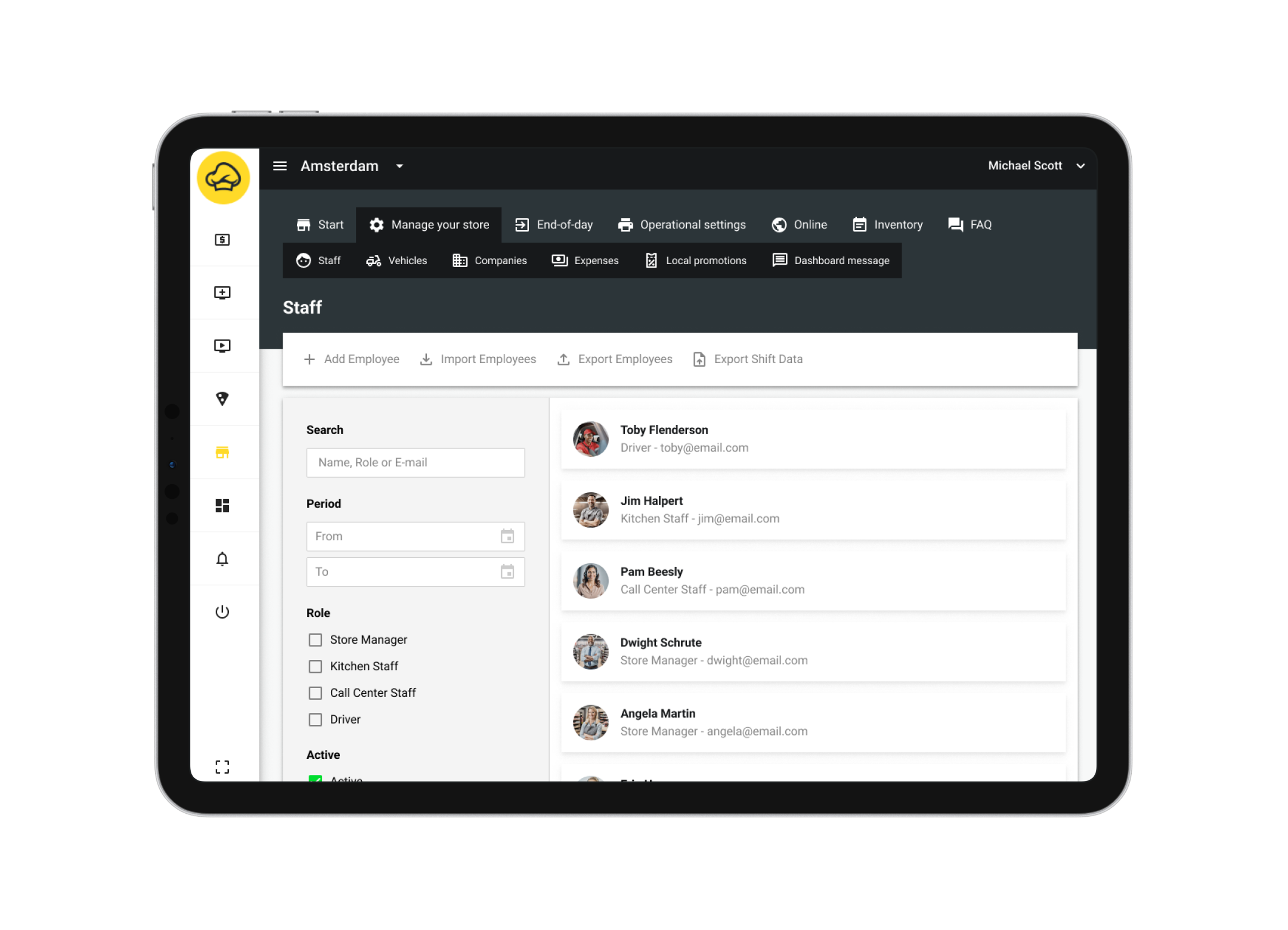
From receipt printing rules and cash drawer behavior to ETA settings, sound notifications, and printer routing, allow managers to define how the POS behaves in daily service.
HR and scheduling without a separate system
Manage employee profiles, vacations, and shift schedules in one place. Assign roles with permissions tied directly to POS access, controlling what each employee can see and do, automatically enforced every shift.
Labor costs you can act on in real time
Clock-in and clock-out flows directly from the POS into labor tracking. Compare scheduled versus actual hours against live sales data, per store. Spot overstaffing, understaffing, or cost imbalances early on, before they affect profitability.
Read more about Staff Management →
Perform daily or scheduled stock counts, log incoming deliveries, and monitor real-time stock deduction as orders are finalized. The system also calculates theoretical usage based on recipes and compares it to actual usage, highlighting variance and potential waste.
Configure delivery zones, set minimum order values, and define delivery fees directly within the system. Pause or throttle delivery and pickup channels during peak demand to maintain operational stability.
Access real-time performance data without waiting for manual reports. Store managers can generate around 60 pre-built reports based on their needs. Some examples are:
Review open orders, clock out staff, reconcile cash per payment type, and finalize daily transactions through a guided end-of-day process. Stock adjustments for cancelled or wasted items are proposed automatically.
End-of-day takes minutes instead of half an hour; guided, consistent, and the same process in every store.
We typically see 3–5% labor cost reduction when scheduled hours are tracked against actual sales in real time, rather than reconciled after the fact.
When theoretical versus actual stock variance is visible daily, most operators reduce shrinkage by 10–20% within the first quarter.
Replacing a standalone HR or scheduling tool eliminates an integration point, a vendor contract, and a login your managers have to remember.
AI-assisted forecasting helps managers schedule the right number of people for the right shifts; reducing both overstaffing costs and service failures on peak nights.
Automated KPI reports mean managers spend time running their store, not building spreadsheets; and head office gets consistent data across every location without chasing anyone.
Apache Pizza is Ireland’s largest pizza delivery and takeaway brand, operating more than 200 stores across the Republic of Ireland and Northern Ireland.
By moving to S4D, Apache replaced a restrictive, closed setup with an open platform designed for continuous experimentation and integration. The brand connects best-in-class tools across delivery, payments, and marketing, including Uber Eats, Just Eat Takeaway, Mollie, Deployteq, and DotDigital, and more.
With the ability to add integrations and run A/B tests across channels, Apache continuously optimizes ordering, marketing, and customer engagement. This approach helped double online sales within three years, reduce dependency on aggregators, and build a flexible foundation that evolves as strategies change.
Read moreabout Apache PizzaWe have several direct integrations, and when we don’t have a direct integration you can use our partner Deliverect to make sure all the orders come into our system. As a result of this, you save time, as you don’t have to upload the menu on all the different platforms, but you can all do it from S4D.
Store employees can use our inventory module on the POS to activate the stock warning for a specific product or option. This will show the product or option as “currently unavailable” on all their S4D sales channels, such as the website and mobile app for online ordering, POS, and self-order kiosks. Customers outside of the delivery area of the restaurant will still be able to order the product and option.
Yes. All of our channels support visuals to make it even easier to choose the right and most appealing product.
We offer support via WhatsApp chat, email, and phone during the store opening hours and according to the SLA.
Our support agents are trained to speak various languages to help in an efficient manner.
When your kitchen, POS, and delivery platforms don’t talk to each other, your staff fills the gap, and mistakes happen.
S4D connects every part of your operation from one place. Menu updates pushed chain-wide in seconds. Orders are routed automatically. No tablets, no workarounds, no chaos.
What this looks like in practice:
The outcome: Less operational friction. Faster service. A setup that scales when you open the next 10 locations.
You built your brand, but delivery platforms are renting it back to you, at 30% commission.
S4D gives you a direct ordering channel that actually converts: a fast, branded website and app your customers want to use, backed by a loyalty program that keeps them coming back.
What this looks like in practice:
The outcome: More orders through your own channel. Lower cost per order. A customer relationship you actually own.
Most chains are making decisions based on incomplete data, or worse, gut feeling. You can’t fix what you can’t see.
S4D gives you a single view across every location, every channel, every order. Not just dashboards, actual insight you can act on.
What this looks like in practice:
The outcome: You stop guessing which locations underperform and why. You make the call with the numbers in front of you.
Deep-dive into what a true omnichannel solution looks like for a multi-location QSR chain
Daan Bakker
Management