Daan Bakker
Management
“I hate when I order something, wait an hour, and then they tell me it’s out of stock. Why let me order it if you don’t have it?”
This is one of the most common customer complaints in QSR and one of the most underestimated operational problems in multi-location restaurant chains.
Running out of ingredients is inevitable. Every restaurant experiences it. What matters most is how the customer experiences it.
For many chains, a simple stock shortage sets off a chain reaction: a kitchen flags something unavailable, someone needs to update the menu, but there are multiple channels (POS, website, app, kiosk, delivery platforms), a queue at the door, and a KDS pinging every thirty seconds. The update doesn’t happen. Orders keep coming in for something the kitchen can no longer make.
The customer who ordered it might not complain. They silently just stop ordering from you again. That’s the real cost. Not the refund. The customer you never win back.
86% of customers hesitate to return after a poor experience.
An out-of-stock notification after an order is placed is exactly that. A broken promise, at the worst possible moment, that could be prevented. At one location, the feedback loop is short enough to manage manually. Someone notices, updates the board, and tells the team. Most mistakes get caught.
At 20+ locations, that loop breaks. Each store manages its own inventory. Each decides when to pull something from the menu. And pulling it means logging into Uber Eats, Just Eat, Deliveroo, the website, and the app, kiosk, separately, one by one, during the busiest hours of the day.
On a quiet Tuesday, that’s manageable. During a Friday night rush, it gets pushed back. Later becomes never.
One customer in the city orders your signature pizza without a problem. Another three kilometers away gets an out-of-stock notification after their order has already been placed. Two different experiences. One brand. No visibility from HQ on which locations are the problem, how often it’s happening, and how to act on it.
This is where the omnichannel advantage becomes concrete.
Chains running disconnected systems are always going to be managing out-of-stock manually. A separate e-commerce platform. A delivery management tool. A standalone POS. It doesn’t matter how good each individual tool is. The gap between them is where the problem lives.
When everything runs on one platform, the logic changes completely. One update. Every channel. Instantly.
When a kitchen marks an ingredient as unavailable, that change goes simultaneously to the website, the app, the kiosk, and every connected delivery platform. The customer, browsing the app three seconds later, sees the item as unavailable. They never place an order that can’t be fulfilled.
That’s what omnichannel infrastructure actually means in practice. A single source of truth that automatically keeps your kitchen and your customer in sync across every channel at once.

Most platforms hide the whole product when an ingredient runs out. Order lost. Revenue gone.
S4D now manages out-of-stock at the ingredient level. Instead of hiding the product, it turns the moment into a recovery opportunity.
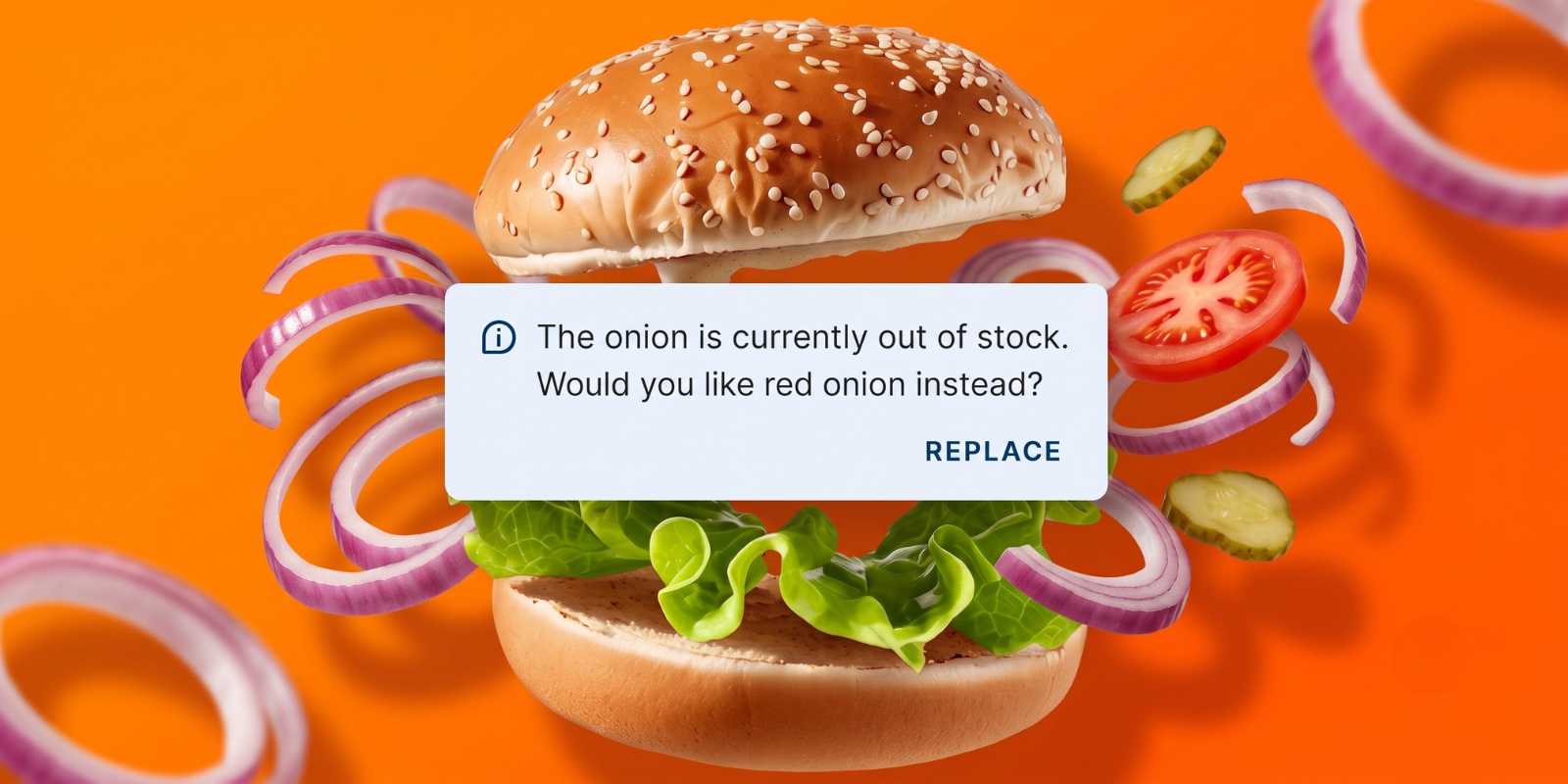
When gorgonzola runs out, every product using it as a default automatically reflects that. The customer sees a notification in their ordering flow with the option to swap it for an alternative topping. They pick a replacement. The order completes. The store never has to make a call. The customer never knows there was a problem.
If a product has a non-editable default topping that runs out, S4D automatically marks the whole product as unavailable. Customers only ever see what the kitchen can actually make.
Every out-of-stock moment that used to mean a lost order is now a chance to keep the customer moving and complete the sale.
Managing out-of-stock in real time solves the immediate problem. Predicting it before it happens is where the real advantage lies.
Most chains order stock based on gut feel, manager experience, or last week’s rough numbers. That works until it doesn’t. A busy weekend, a promotional push, a World Cup match that drives double the usual pizza orders, and suddenly a location is short on ingredients it should have had.
S4D’s Inventory Management changes that. Based on real sales data, store managers can see their daily stock needs before the shift starts. Not a rough estimate. A forecast built from actual order history, so the right ingredients are ordered in the right quantities, at the right time.
For a chain running at least 20 locations, this means fewer last-minute shortages, less waste from over-ordering, and a store team that spends less time on manual calculations and more time running the kitchen.
Four in five customers say technology influences where they order from. Menu accuracy, real-time, ingredient-level, across every channel, is part of that experience. Not the most glamorous part of running a restaurant. But one of the most directly connected to whether a customer comes back.glamorous part of running a restaurant. But one of the most directly connected to whether a customer comes back.
See how S4D handles stock management, down to every ingredient.
Daan Bakker
Management